A water pipe bursts at 2 a.m. A fire damages your kitchen. You discover mold spreading behind a bathroom wall. In each case, the first hours determine how much damage can still be stopped.
Most Denver homeowners have never been through a major property damage event. They don’t know what a restoration company does when they arrive, what decisions they’ll be asked to make, or how the process unfolds over the first 24-72 hours. This guide walks through all of it.
Before the Restoration Team Arrives: Your First Steps
The first few minutes after discovering damage set the stage for everything that follows. Here is what to do before making any other calls:
For water damage:
- Locate your main water shutoff and turn it off if the source is a plumbing failure
- Turn off electricity to any area where water is present – do not enter flooded rooms if electricity may be live
- Move personal items, important documents, and valuables out of the affected area if you can do so safely
- Do not use fans or heating until you know the category of water (contaminated water spread by fans creates a larger biohazard zone)
- Take photos or video of everything before any cleanup begins
For fire or smoke damage:
- Do not re-enter the structure until fire personnel have cleared it as safe
- Ventilate if safe to do so, but do not use electrical appliances or HVAC until the system has been inspected
- Do not attempt to clean soot from surfaces – improper cleaning can permanently set soot stains
- Secure the structure against weather and unauthorized entry if there are openings in the exterior
For mold discovery:
- Do not disturb visible mold – brushing, scrubbing, or blowing air on mold colonies releases large numbers of spores into the air
- Identify and stop any active water source contributing to moisture
- Keep HVAC off in the affected area to avoid distributing spores to other parts of the home
- Keep people with respiratory sensitivities or compromised immune systems away from the area
Then call a 24/7 restoration company. Time matters – the EPA is direct that materials not dried within 24-48 hours of a water event will likely develop mold growth.
Hours 0-2: The Emergency Response Call and Dispatch
A professional restoration company operating 24/7 – like Anatom Restoration across Denver and the Front Range – responds to emergency calls at any hour. When you call, expect to provide:
- Your name and the property address
- A brief description of the type and apparent scale of the damage
- Whether the source of damage is still active
- Whether the property is safe to enter
The dispatcher will give you any immediate safety instructions and dispatch a technician team to your location. Response time varies by distance, but the goal of any reputable restoration company is to have technicians on-site within a few hours of your call – especially for active water intrusion.
What the team brings on first response:
- Moisture meters and thermal imaging cameras for rapid assessment
- Personal protective equipment appropriate to the damage type
- Water extraction equipment for standing water
- Containment supplies (plastic sheeting, tape, air movers)
- Documentation equipment – cameras, measuring tools, and paperwork
Hours 2-6: Assessment and Documentation
The first thing a professional restoration team does is assess – not just the visible damage, but the full scope of what has occurred. This is one of the most important steps in the entire process, and it is one that DIY cleanup almost always skips.
Moisture mapping – for water damage events, technicians use pin-type and pinless moisture meters to map the full extent of water migration through building materials. Thermal imaging cameras reveal moisture patterns inside walls by detecting temperature differences between wet and dry material. This establishes the true boundary of the damage zone.
Category and class determination – under the IICRC S500 Standard for Professional Water Damage Restoration, technicians classify the water source by contamination level (Category 1-3) and the extent of saturation by material porosity and spread (Class 1-4). These classifications drive every subsequent decision about equipment, containment, safety, and timeline.
Documentation – every affected area is photographed, measured, and logged. Moisture readings are recorded as baseline data against which daily drying progress will be measured. This documentation also serves as the foundation for any insurance claim. Anatom Restoration documents damage thoroughly, though the decision to file a claim is always yours.
Emergency stabilization – if there are structural concerns, openings in the exterior, or active water intrusion that has not been fully stopped, the team addresses those immediately.
Hours 4-12: Extraction and Initial Setup
Once assessment is complete and the scope of damage is documented, the emergency mitigation phase begins in earnest.
Water extraction – for water damage events, professional extraction equipment – truck-mounted or portable units with far greater capacity than consumer wet-dry vacuums – removes standing and surface water from floors, carpeting, and accessible areas. This is not the end of the drying process; it is the beginning.
Content protection and pack-out – furniture and personal items in the affected area are either protected in place (raised off wet surfaces, wrapped if necessary) or removed for cleaning and storage. For significant damage, a formal content pack-out may be initiated, where items are catalogued, transported, and cleaned at a professional facility.
Containment setup – for contaminated water (Category 2 or 3) or mold events, plastic sheeting containment and negative air pressure are established to prevent contamination from spreading to unaffected areas of the home. Air scrubbers with HEPA filtration run continuously in the containment zone.
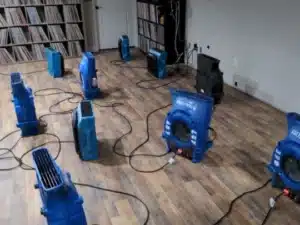
Drying equipment placement – IICRC ASD (Applied Structural Drying) certified technicians position air movers and dehumidifiers based on a calculated drying plan that accounts for the size of the space, the materials involved, the ambient temperature and humidity, and – critically for Denver – the altitude. Equipment at 5,280 feet performs at lower efficiency than sea-level ratings; professionals account for this when sizing and placing equipment.
For smoke damage from fire or nearby wildfires, the initial setup may instead focus on sealing the structure, establishing airflow to remove particulate-laden air, and beginning surface documentation for the cleaning scope.
Hours 12-24: First Monitoring and Scope Finalization
After equipment is running, the restoration team makes a monitoring visit within the first 12-24 hours to check drying progress and adjust the equipment plan if needed.
What gets checked at the first monitoring visit:
- Moisture readings at all documented measurement points – is the drying system working as expected?
- Dehumidifier water collection – full tanks indicate the system is pulling significant moisture from the air
- Temperature in the drying zone – effective structural drying requires maintaining temperatures above 70°F to optimize evaporation
- Equipment function – are all air movers and dehumidifiers operating correctly?
This visit also often includes a more detailed conversation about scope – specifically, whether any building materials need to be removed to allow drying to proceed. Drywall that is saturated beyond the threshold where it can dry in place, wet insulation inside wall cavities (insulation almost never dries effectively in place), and deteriorated flooring may need to be removed during this phase.
Material removal during the emergency mitigation phase is not demolition in the traditional sense – it is strategic and targeted, removing only what must be removed to allow the structure to dry and to prevent mold growth. It is far less expensive than the alternative: discovering hidden mold two months later and removing finished surfaces at that point.
Hours 24-48: Daily Monitoring and Adjustments
Day two of the drying process involves continued monitoring, equipment adjustment, scope confirmation, and decisions about materials that may need removal.
Daily monitoring visits include:
- Updated moisture readings at all documented points
- Psychrometric data logging – temperature, relative humidity, and dew point in the drying zone
- Equipment adjustments – repositioning air movers, emptying or adjusting dehumidifiers, adding or removing equipment as conditions change
- Assessment of any newly identified moisture migration as drying exposes previously saturated areas
The IICRC WRT (Water Damage Restoration Technician) certification covers exactly this process – understanding water damage effects, drying techniques, and the technical monitoring needed to verify that structural drying is proceeding on schedule.
You should expect your restoration team to communicate daily during the drying process. If a company installs equipment and disappears until they come back to remove it, that is a red flag.
Hours 48-72: Drying Progress, Clearance, and Transition to Reconstruction
By the 48-72 hour mark, most standard water damage projects show significant drying progress. Some projects – particularly those involving multiple-story structures, concrete slab subfloors, or Category 3 water – take longer.
What happens at the 72-hour mark:
For projects progressing on schedule, the team assesses whether materials have reached or are trending toward dry standard. When moisture meter readings confirm that all affected materials have returned to safe moisture content – not before – the drying equipment is removed and the structure is documented as dry.
For mold events, post-remediation clearance testing verifies that mold levels have returned to acceptable ranges before reconstruction begins.
The transition to reconstruction:
Once emergency mitigation is verified complete, the restoration project moves to the reconstruction phase – replacing drywall, reinstalling flooring, repainting, and returning the space to its pre-loss condition. This phase is separate from mitigation and typically involves a scope of work and timeline that your restoration contractor will walk you through in detail.
Anatom Restoration handles both mitigation and reconstruction, which means one point of contact for the entire project – from the emergency call through the final walk-through.
A Note on Insurance Coordination
Emergency restoration work generates significant documentation: moisture logs, scope reports, photographs, equipment records, and material removal documentation. Anatom Restoration organizes all of this documentation. We do not file claims on your behalf, but we can walk you through what we’ve documented and what information your insurer will likely need, including photos, affected-room notes, equipment records, and repair scope details.
The Emergency Restoration Timeline at a Glance
| Timeframe | What Happens |
| Hours 0-2 | Emergency call, dispatch, initial guidance |
| Hours 2-6 | Initial arrival, assessment, moisture mapping, documentation, source control |
| Hours 4-12 | Water extraction, containment setup, drying equipment placement |
| Hours 12-24 | First monitoring visit, equipment adjustment, scope refinement |
| Hours 24-48 | Daily monitoring, psychrometric logging, material removal if needed |
| Hours 48-72 | Continued drying, clearance assessment, transition planning |
| Day 3+ | Final verification, equipment removal, reconstruction phase begins |
Emergencies Can’t Wait, Call Us Now!
Dealing with an active emergency in your Denver, Aurora, Centennial, or Front Range home? Anatom Restoration responds 24/7 to water, fire, smoke, and mold events. Call now for immediate dispatch – the sooner we start, the less damage has time to spread.